
Hidden Springs Homestead may earn a commission for purchases made after clicking links on this page. Learn More.
Planting and growing green beans in your home garden is easy to do with these tips. You can be growing green beans as soon as this spring.
Green beans are a staple of so many gardeners since they grow incredibly easily and are extremely productive even in small spaces. Use this simple guide to learn how to plant, grow and harvest green beans from seeds in your own backyard.
Growing green beans is one of those things you can’t understand until you have tasted homegrown. The beans that come in a can at the grocery store are no comparison. That’s why when making my garden plan each season, they are always on top of the list.
If you are a beginner and looking for an easy vegetable to grow that can include the kids, growing green beans from seeds is perfect! The seeds are a nice size for little fingers.
Varieties of Green Beans
Before we begin planting green beans, I feel like we need to talk about varieties first. There are several varieties of green beans that can be grown on the homestead or in the backyard vegetable garden. I’m not sure of the exact number of varieties, but I do know there are well over 50.
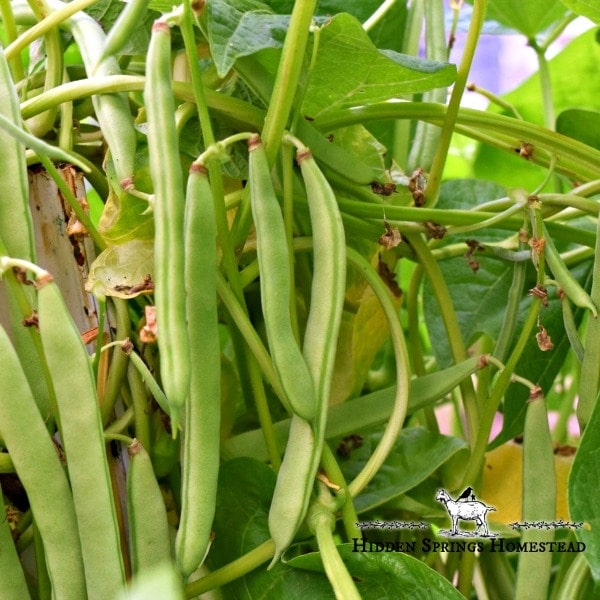
Several green beans can be stringless. Meaning they don’t require removing the string during preparation. They can also vary in different sizes, textures, and even colors.
Green beans fit into two categories: Bush Beans and Pole Beans. So what is the difference between bush and pole beans? The main difference between the two is support.
Bush Beans:
Green Bean Bush varieties will grow to 2-3 feet tall. These are great for small spaces and even raised beds. Bush beans produce all at once – usually in 5-7 weeks. So if you want to can green beans or freeze them, bush beans are a great choice.
Bush beans prefer to be planted in dual or linear rows to support each other. Trellising is not necessary for them. Blue Lake bush beans are my choice for my raised beds.
Since the rows grow together to support each other, the green beans are a bit difficult to find on the vine.
Pole Beans:
Pole bean varieties grow to about 5-6 feet tall. They have tiny tendrils that reach out and cling to a trellis, fence post, or whatever they can grab and climb. Therefore, pole beans do have to be trellised in some way.
Since they are trellised, pole beans produce more than bush beans in less space. They are the perfect variety for vertical gardening.
Pole bean varieties don’t produce all at once, though. Instead, they will continue to produce up until frost as long as you keep them picked. They are probably easier to pick than bush beans as well.
With vertical gardening, you don’t have to bend over to pick, and the bean pods are much easier to see on the vine than bush beans. So how do you know if you have pole beans or bush beans? A couple of ways to tell the difference. The seed packet will identify if the seed is a bush or pole bean.

If you don’t have a seed packet, another way is to plant them and watch for the little tendrils that appear really early in the growing phase. If tendrils appear, add a trellis.
Last season I planted heirloom Blue Lake Bush beans and apparently had a couple of pole beans mixed in the seed. In a section of my dual rows, I notice tendrils start wrapping around the Blue Lakes. Realizing what it was, I fixed up a trellis over these couple of bean plants, and the problem was solved.
RELATED: Even if you’ve never gardened before, this Vegetable Gardening for Beginners Ultimate Guide is for you! Learn everything you need to know from over 60 resources, all in one place, to be a successful gardener, including improving soil, cover crops, warm and cool season crops, organic amendments, fertilizing, watering, and so much more.
How to Grow Green Beans From Seed to Harvest
Fortunately, it’s not necessary to start seeds indoors when you grow green beans. They prefer to be planted directly into garden soil since they don’t transplant well.
Do you need to soak green beans overnight? It is also not necessary to soak green beans overnight, but it will help to speed germination.
Depending on the variety, bush or pole – they are planted just a bit differently.
How to Plant Green Beans
Both pole beans and bush beans are planted pretty much the same. Green beans are light feeders and don’t require fertilizer.
Prepare soil ahead of time. When planting, add mature or aged compost, and this should be all the fertilizer you need if you are starting with healthy soil. I would highly recommend a soil test. You can go here to find your local extension office to help you with the process.
If your soil does need some organic amendments, one very good one is compost tea, which you can learn how to make in this article.
If you need to know more about growing vegetables, here’s a great place to learn how to start a garden. Once you have your soil ready, the work will be easier using just a couple of simple tools needed for gardening, and you’ll be all ready to put beans in the ground!
How to Plant Bush Beans
- Bush beans should be planted in linear rows to support each other.
- Place the seed 1 inch deep into the soil and space them about 4 inches apart.
- They will germinate in 7-10 days. You can speed this germination time up by soaking seeds overnight.
- Since bush beans produce all at once, they are great for succession planting about 2 weeks apart. This will help to extend your growing season.
To make the most of the space you have, before you begin, create a garden map to maximize your space – spacing, succession planting, trellising, and more!
If you use the Square Foot Gardening method, you can get 9 plants per square foot.
How to Plant Pole Beans
- Soil for pole beans should be well drained
- Plant seeds 1 inch deep and about 4 inches apart
- Depending how you will be trellising will depend on how to plant. They can be planted in rows with a trellis down the middle. Or, they can be planted in a teepee style.
To learn more bout teepee-style planting, The Old Farmers Almanac has this great video. And, of course, if you use the Square Foot Gardening method, you can get 8 plants per square foot.
RELATED: Take the guesswork out! Use the easy formula worksheets in The Canning Garden Workbook (printable) to figure out how much to plant, for canning, to feed your family for a full year!
When to Plant Green Beans
Green beans are not frost tolerant. So they need to be planted after the threat of frost has passed. To find the last frost date in your area, take a look at the last frost date estimator. In most areas, this is from late April to mid-June.
Soil temperatures need to be at least 60-65°F. If not, germination will be slower. Another way to speed germination of seeds is to wait until the soil is at least 70°F.

How Long Does it Take For Green Beans To Grow?
There are so many different varieties of green beans to choose from, but for the most part, they take about 50-65 days to produce fruit.
A good reminder I didn’t think of early is the days to harvest on the seed packet. This is from the day you plant them into the garden soil. This is if you waited until the soil conditions were warmed to about 60-65°F. If soils were cooler, it could take a bit longer for beans to grow and be ready for harvest.
How Much Sunlight Do Green Beans Need?
You should grow your green beans in a place that gets at least 6-8 hours of full sun daily; 10 is even better. They don’t do well or may not grow at all in the shade. They are heating loving plant that enjoys full sun.
How to Water Green Beans
How much water does a green plant need per day? Beans develop fruit through a process called photosynthesis which takes a lot of both sunlight and energy received from the water. Prior to blossoming, bean plants need 1 inch of water per week.
But once they start blossoming, they use about a 1/2 inch of water each day. This is for bean pod growth from the blooms. As a result, bean plants need or should be watered daily during this period. If beans become too dry during this time, they could experience a blossom drop.
When watering green beans, try to avoid getting the leaves wet. This will prevent disease. Instead, focus the water on the root system and allow it to soak deep into the soil. Here in Tennessee, we tend to have very dry summers, and watering is completely necessary.
Harvesting Green Beans
What is the best time of day to pick green beans? Early morning is best. I like to have my green beans harvested and back inside before 9 am. This will ensure the pod is crisp and not wilted from the summer temperature.
A plant normally produces a 120:1 ratio. Meaning that every plant will produce about 120 beans. They normally grow in “pods.” So you’ll have about 20 pods per plant.
How can you tell when they are ready to pick?
There are a couple of ways to do this. First, look at the seed packet and see how many days from planting does your variety mature. How many days does it say, or how long should your beans grow? This is the first way.
A second way is to look at the thickness of the bean pod itself. You’ll want to pick them when they are a bit thick but before they begin to swell. If you bend one in half, and it “snaps,” this is a good indication they are ready for harvest.

How do you pick green beans off the plant?
Since bush beans produce all at once, you can easily grasp hold of the entire pod with one hand and hold the plant with the other. Gently pull the whole pod at once since it will not be producing more beans.
For harvesting pole beans, it is just a bit different. As I mentioned earlier, they will continue to produce right up until frost. So they need to be harvested in a more gentle manner. With a pair of sharp scissors or sharp point pruning shears, hold beans with one hand and cut them individually from the vine. This helps to ensure you don’t injure the vine, and it can continue to produce until frost.
By the way, did you know that you can save seeds to plant next year? Take a look at this seed-saving article from Lesa at Better Hens and Gardens. Saving seeds makes complete sense. You’ll not have to buy seeds next season.
Common Types of Bush Green Beans
- Blue Lake – Ready to harvest in 60 days, a dark green heavy-yield plant. The pod grows to about 6 inches long.
- Cantare – Harvest in about 50-55 days. Superior producer of a very straight slim 4-5 inch pod.
- Contender – Ready to harvest in approximately 50 days. Produces high yields of beans.
- Empress – Ready to harvest in 55 days. A snap bean for fresh eating, freezing, and processing, 5-6 inch pods
- Burpee’s Stringless – Harvest in 45-50 days. A totally stringless bean that is about 5 inches long
- Landreth Stringless – Ready to harvest in about 55 days. Pods are medium size, about 5 inches long; the bean is a rich brown or chocolate color.
- White Half Runner – Ready for harvest in 60 days on average. A heavy producer with pods about 4.5 inches long and white seeds that have a sweet flavor.
Common Types Of Pole Beans
- Kentucky Wonder – Grows in large clusters of 7-10 beans that are about 7 inches long. It can be harvested in about 65 days.
- Rattlesnake Snap -Dark green pods that are about 8 inches long and have a purple streak that grows in them. They can be harvested in about 65-90 days.
- Lazy Wife – Ready to harvest in 80-100 days. Pods grow to about 7 inches long and are completely stringless.
I mentioned earlier there are over 50 varieties of green beans that grow in all different sizes and colors. To learn what a great variety is for your zone and area, I’d recommend requesting a few different free seed catalogs and reading about all the different types. If there is a catalog that may cater to your specific region or area, I’d highly recommend you request it.
By the way, when you are ordering seeds, don’t get carried away and lose your budget. In my first years of gardening, I wanted to order everything in the catalog. Take a look at these 5 Seed Ordering Tips to Save Time and Money will help a lot, I promise.

What Are Good Companion Plants For Green Beans?
Keep green beans from Parsley and Lettuce.
Plant Markers I Use In My Raised Bed Garden
I thought this to be a good time to share with you how I keep my plants marked in the garden. This helps to know what variety I have in each space. I’ve used paint sticks in the past, but they would rot, and the name would fade before the season was over.
My friend introduced me to these waterproof markers and these simple little inexpensive T-type marker tags. They are nothing fancy but work really well.
I have found these to be extremely helpful not only with vegetable gardening but also with flowers too. I’m building a native plant garden to attract pollinators, and since I’m still learning my native plants, these are super helpful.
More Garden Growing Tips:
- Growing Potatoes, All You Need To Know
- How to Grow Healthy Tomatoes Organically
- Growing Cucumbers (Plant, Grow, Harvest)
- How To Grow Cabbage In A Home Garden
- How To Can Green Beans
Enjoy your harvest!

Connect with Hidden Springs Homestead!
Be sure to follow me on social media so you never miss a post!

Dianne Hadorn is the owner of Hidden Springs Homestead, nestled in the hills of East Tennessee. A Master Gardener and lifelong homesteader, she teaches families how to grow real food, preserve it with confidence, and depend less on the grocery store. Through her practical, down-to-earth approach, Dianne has become a trusted source for beginners who want to build a sustainable lifestyle and fill their pantries with food they’ve grown themselves.
My green bean leaves look like they have sun scald. Do you know what causes this. I live in mIssouri. Usually they start to look like this at the end of the season. Thanks
Hi Gail,
This could very well be actual sun scald from the intense sun rays. But without seeing images, I’m not totally sure. BUT – if your garden is getting over 8 hours of intense sun a day – most likely it is this. Go ahead and remove those leaves, give your beans some extra water, more than the 1 inch per week to help them endure. And, if at all possible, can you figure out a way to maybe give them some shade?
But since it really doesn’t start to the end of the season, it may be that they are just done. They are an annual and only live for so many weeks. IF they are producing well, I’d just keep watering until you are ready to pull them up. Here in Tennessee, August is really hard on the garden due to the heat and sun – so I always increase my watering. But mine are done by this time as well and it’s time to plant the fall garden too.
Let me know if this helps,
Dianne
Hi Dianne, I think I’ve done every variety of bean you recommended at one point. For my raised beds, I have been sticking with Contender bush beans lately. They produce consistently, are hardy and pest-resistant and the beans are nearly stringless. My family loves them! Thank you for the very thorough article!
Hi Willow, I’m so glad you enjoyed it. I do agree, the Contender is a delicious bean. Thanks for reading.